
On July 10, the Faculty of Veterinary Medicine had the honour of welcoming members of the Molson Foundation for an exclusive visit of the new Veterinary Simulation and Virtual Reality Centre on the Saint-Hyacinthe campus.
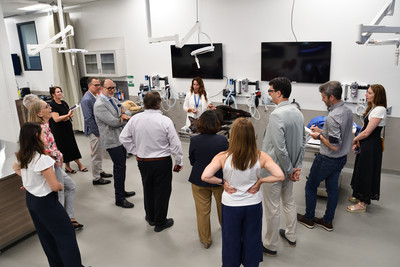
In attendance were Mr. Andrew Molson, Chair of the Molson Foundation; Ms. Stéphanie Pineda, Manager of Donations and Community Relations at the Molson Foundation; Ms. Megan Armitage, Donations Coordinator at the Molson Foundation; along with Dr. David Francoz, Dean of the Faculty of Veterinary Medicine; Mr. Michael Pecho, Vice-Rector of Philanthropy and Alumni Engagement at the Université de Montréal; and Mr. Daniel Jutras, Rector of the Université de Montréal.
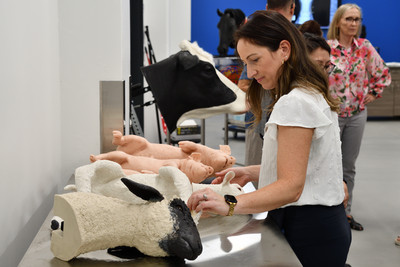
The purpose of the visit was to highlight the Molson Foundation’s exceptional contribution to the creation of this cutting-edge training centre. Thanks to a one-million-dollar donation from our valued partner, the faculty acquired animal models and virtual reality equipment.
Since the fall, students at both the Saint-Hyacinthe and Rimouski campuses have been exploring this new learning environment. The simulation tools allow them to practice a wide range of techniques, including suturing, bandaging, injections, palpations, tracheotomies, cardiopulmonary resuscitation, anesthesia, and dental procedures. This learning approach reduces students’ stress levels by allowing them to train on simulators before working with live animals. It is also aligned with the regulatory policies of the Canadian Council on Animal Care, as it limits the use of animals for teaching purposes.
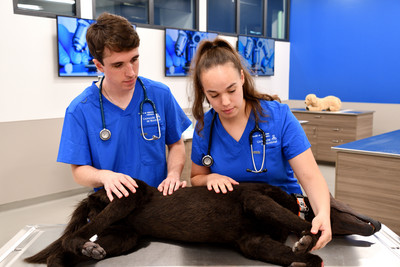
Accessible 7 days a week, from 6 a.m. to 11 p.m., the centre offers students great flexibility to refine their skills and build confidence. Thanks to glassed-in rooms overlooking the main lab, instructors can easily observe learners in action and provide feedback. The layout also supports the simulation of interactions between practitioners and animal owners, strengthening students’ communication and client-relations skills.
The faculty also plans to expand the scope of its centres by opening them to continuing education for veterinary practitioners, as well as to students in animal health technology programs.
Photo Credit : Christophe Dubé